
When you walk into a library today you might notice something interesting. There are no queues. There is no stamping. Books get issued in seconds.
It almost feels effortless.
Behind this experience is a technology that many people do not fully understand. RFID.
If you have been hearing the term but are not quite sure what it means you are in the place. In this guide by elibsol we will break down what RFID is, how RFID works and why RFID for library in India is becoming essential than optional.
What is RFID
Let us keep it simple.
RFID, which is Radio Frequency Identification is a technology that uses radio waves to identify and track objects automatically.
Unlike barcodes RFID does not need to be scanned one by one. There is no need to align anything perfectly. The RFID system just works.
In terms:
RFID lets objects send information wirelessly to a system without physical contact.
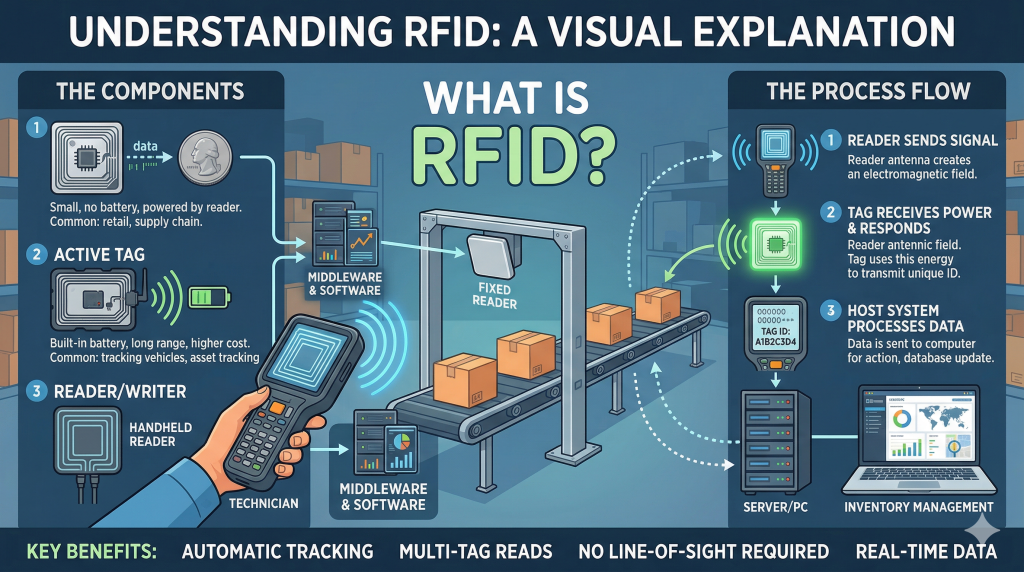
How RFID Works
Most people assume RFID is complex. It is not.
Here is what actually happens:
A small RFID tag is attached to an item, like a book.
A reader sends out radio signals.
The tag responds with its stored data.
The RFID system. Processes that data instantly.
All of this happens in a fraction of a second.
Now imagine this in a library.
Of scanning books one at a time multiple books can be detected at once. Even while stacked. That is the power of RFID technology.
Core Components of RFID Systems
Every RFID setup whether in retail or libraries relies on a key elements:
- RFID Tags
These are chips placed inside books or items. They store information.
- RFID Readers
Devices that communicate with tags using radio waves.
- Antennas
They help transmit signals between tags and readers.
- Software
This is where everything comes together. Data gets recorded, tracked and managed.
Types of RFID Tags
Not all RFID tags are the same. Choosing the one matters.
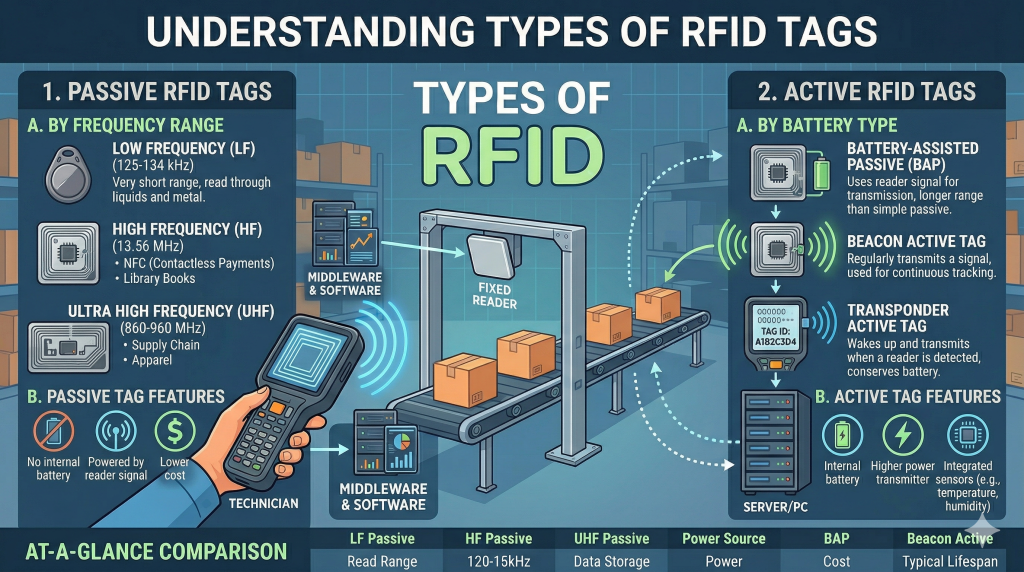
Passive RFID Tags
No battery.
Powered by reader signals.
Affordable.
Ideal for libraries.
Active RFID Tags
Battery-powered.
Longer range.
More expensive.
Used for tracking high-value assets.
Semi-Passive Tags
Combine features of both.
Better performance in environments.
For RFID for library in India passive tags are the practical and widely used option.
RFID Frequency Explained
RFID systems operate on frequency levels and each serves a purpose:
Frequency Range Common Use
LF, which is Low Frequency, Short Access control
HF, which is High Frequency, Medium Libraries smart cards
UHF, which is Ultra High Frequency, Long Warehousing
Most libraries use HF RFID as it offers the balance of accuracy and range.
Let us be manual systems slow things down.
RFID changes that completely.
Key Benefits:
operations. Issue multiple books instantly.
Accuracy. Fewer human errors.
No line-of-sight needed. Works through stacks.
Real-time tracking. Always know where items are.
Reduced workload. Staff can focus on tasks.
This is why RFID applications are expanding rapidly across industries.
RFID for Library in India: A Practical Shift
Now let us bring this closer to home.
Libraries in India are evolving. Students expect service. Institutions demand tracking.
That is where RFID for library in India comes in.
With solutions from elibsol libraries can:
Automate book issue and return.
Track inventory in minutes of days.
Install -theft security gates.
Enable self-service kiosks.
Reduce queues and manual work.
It is not just about technology. It is about improving the user experience.
Real-Life RFID Applications
RFID is not limited to libraries. It is everywhere.
Retail
Stores use RFID to track inventory and prevent theft.
Healthcare
Hospitals track patients and equipment in time.
Logistics
Companies monitor shipments across the supply chain.
Libraries
From checkouts to security RFID simplifies everything.
RFID vs Barcode: What is the Real Difference
Here is a quick comparison:
Feature RFID Barcode
Scanning No line-of-sight needed Requires direct scan
Speed fast Slower
Data Capacity High Limited
Automation High Low
Durability Strong Easily damaged
Barcodes are still useful. But when scale and speed matter RFID wins.
Challenges You Should Know
No technology is perfect.
RFID comes with a challenges:
Higher initial investment.
Signal interference, with metal or liquids.
Setup complexity.
Privacy concerns if not managed properly.
That said these issues are becoming less significant as technology improves.
The Future of RFID
Here is where things get interesting.
RFID is not just growing. It is evolving.
Integration with IoT systems.
AI-powered. Analytics.
Smart. Libraries.
Automated environments.
For India in education RFID is set to play a major role in digital transformation.
Final Thoughts
So what is RFID.
It is an idea with powerful impact.
A technology that replaces effort with automation. That saves time. Reduces errors.. Improves experiences.
For institutions adopting RFID for library in India it is not an upgrade. It is a long-term advantage.
With providers like elibsol making this shift is easier than ever.
❓ FAQs
- What is RFID in terms.
RFID is a technology that uses radio waves to track and identify objects automatically.
- How is RFID used in libraries.
It helps book issuing, returning, tracking and security.
- Is RFID better than barcode.
Yes, for speed, accuracy and automation.
- What type of RFID is used in libraries.
Most libraries use HF RFID tags.
- Is RFID expensive for libraries, in India.
It requires investment but saves cost in the long run through efficiency.